
The short version: Santa Teresa is at its best with kids around 8 and up and with teens, stays in a villa or family suite with a pool, and splits its time between the tide pools, the calm Gulf side and a first surf lesson. With toddlers, it can still work, but many families base themselves in Sámara or Nosara instead (see Santa Teresa vs Nosara).
Where can kids swim safely?
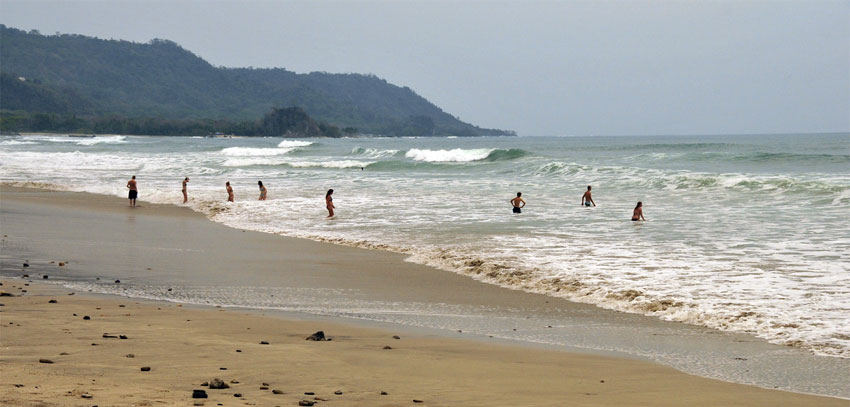
The Pacific beaches in front of town (Playa Carmen, Santa Teresa, Malpaís) are surf beaches with rip currents and no lifeguards to count on. Treat them as places to dig, run and paddle at the edge, not to swim. For swimming:
| Where | From Santa Teresa | What it's like | Best for |
|---|---|---|---|
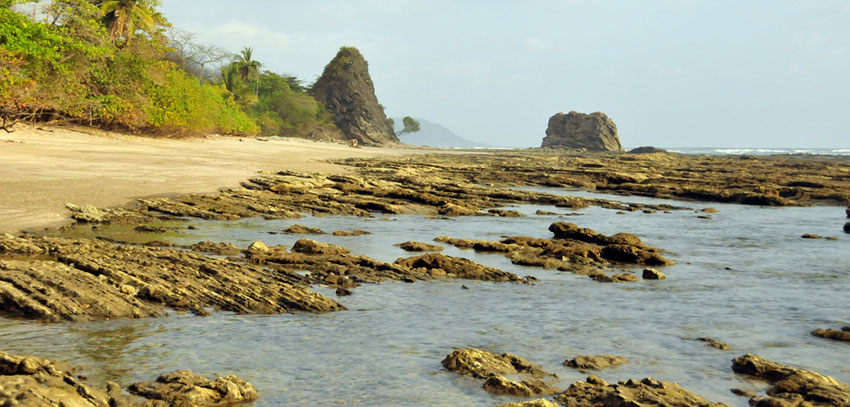
| Malpaís tide pools (Mar Azul) | About 15 min | Rock pools at low tide, some deep enough to snorkel; watch for sea urchins | All ages, with water shoes |
| El Peñón tide pool, Santa Teresa | In town | A rock pool for swimming and snorkeling at low tide | Kids who swim |
| Playa Hermosa | 15–20 min | Sandy bottom, gentler waves; currents toward the north end | Paddling, first surf lessons |
| Isla Tortuga | A day trip by boat | Calm, clear water and a white-sand beach | Snorkeling, all ages |
| Curú | About 1 h 10 | A wildlife refuge with a calm bay and gentle waves | Swimming and wildlife |
| Playa Tambor | About 45 min | A wide, calm bay | Swimming |
The Gulf of Nicoya side is the family secret of this area. It's the other side of the same narrow tip of the peninsula, so calm water is never more than an hour away. More in Tambor and Curú.
How do you stay safe in rip currents?
Costa Rica records 150 to 200 drownings a year, and most beaches have no lifeguards, though the tourism board has put up warning flag signs at about 100 of them. A few rules keep families safe:
- Swim only where it's calm, and never alone. Keep young kids within arm's reach in the water.
- Look for a rip before you go in: a gap in the breaking waves, darker or choppier water, or foam moving out to sea.
- If you're caught, don't fight it. Stay calm, float, and swim parallel to the shore until you're out of the current, then swim back at an angle.
- If someone else is in trouble, call for help and throw something that floats rather than swimming out.
- Keep out of river mouths, where the current is strongest.
Insider tip: plan the tide pools around the tide table, not the clock (the nearest official one is Puntarenas, on the national weather service site). Go at low tide in the morning, with water shoes and a rash guard, and you'll have them almost to yourselves before the sun gets strong.
Surf lessons for kids and teens
A first surf lesson is the highlight for many teens. Book it at Playa Hermosa, the area's beginner beach, not at Playa Carmen, which is a break for intermediate and advanced surfers. Surf shops all over town and many hotels book lessons, and each school sets its own minimum age, so ask when you book. Santa Teresa suits older kids and teens; for younger kids, Sámara's calm bay is easier. More in our first surf lesson guide.
Car seats, transfers and small planes
Costa Rican law requires car seats for children 12 and under, up to 145 cm (57 in):
- Under 1 year: rear-facing.
- 1 to 4 years: forward-facing.
- 4 to 6 years: a booster with a back.
- 6 to 12 years: a booster seat.
Licensed tourist vans aren't legally required to provide car seats, and what shuttle companies supply varies. Tell your transfer company each child's age and weight when you book and get the seats confirmed in writing, or bring your own; an FAA-approved seat doubles as a seat on the plane. On the 30-minute flight from San José to Cóbano airport (ACO), SANSA seats children under 2 on a lap and limits strollers to 7.2 kg (about 16 lb), so pack light. The drive from San José takes 5½ to 6 hours with the ferry, so break it with stops and aim to arrive before dark (sunset is between about 5:15 and 6 p.m.). See getting to Santa Teresa.
Where is the nearest clinic and hospital?
- Clinic: the public Clínica CCSS in Cóbano, next to the municipality, about 30 minutes from Santa Teresa. It's small.
- Local posts and doctors: there are public primary-care posts (EBAIS) in Santa Teresa and Malpaís with weekday hours, and private doctors in the area. Ask your hotel for the one they use.
- Pharmacy: Farmacia Amiga at the Playa Carmen crossroads, and more in Cóbano.
- Hospitals: Puntarenas, 3 to 4 hours by road and ferry, and Nicoya, 2½ to 3 hours by road. Serious cases may need an air transfer to San José, and night flights from this area are restricted.
- Emergencies: call 911.
That distance is the main reason to bring travel insurance that covers medical evacuation, to pack a basic first-aid kit and any medicines your kids need, and to take the waterfalls and the waves slowly.
Money, roads and dust
- ATMs: Banco Nacional, BCR and BAC at the Playa Carmen crossroads, BAC in Santa Teresa, and Banco Nacional in Cóbano (its outdoor ATM runs 6 a.m. to 10 p.m.). In peak season the queues are long and machines occasionally run out, so keep some cash in reserve.
- Gas: there's no gas station in Santa Teresa; the nearest are in Cóbano, 25 to 30 minutes away.
- Roads: the town road is dirt and gravel, with only short paved stretches. It's dusty from December to April and muddy and potholed from May to November, and it's poorly lit at night.
- Getting around: the road is busy with cars, ATVs and motorbikes. Walk with a flashlight after dark, and use taxis at night.
What to pack
- Water shoes for the tide pools, rocky beaches and the Montezuma waterfall trail.
- Rash guards, sun hats and reef-safe sunscreen.
- Insect repellent and light long sleeves for the evening.
- A headlamp or flashlight for the unlit road.
- Sunglasses and a light scarf or buff for dust in the dry season.
- Car seats or boosters, unless your transfer company has confirmed them.
- A first-aid kit, children's medicines and copies of any prescriptions.
- Small bills for tips and small shops.
Where should families stay?
Pick a villa or a family suite with a pool, away from the main road. Nantipa has suites for three adults and a child and beachfront villas for up to seven. For kitchens and space, look at Casas de Soleil, Griss Lodge, Fuego Lodge or Villas Santa Teresa. Playa Hermosa and north Santa Teresa are quieter, and Malpaís is closest to the tide pools and Cabo Blanco. Check the child policy before you book: Hotel Fermata has no cribs or extra beds, and Playa Cielo has listed a minimum check-in age of 18. Our where to stay in Santa Teresa guide lists every hotel we profile, and villas has the rental houses.
A 5-day family plan
Cabo Blanco is closed on Mondays and Tuesdays, so slot day 4 on a Wednesday to Sunday, and check the tide table for the tide-pool mornings.
- Day 1: arrive. Fly from San José to Cóbano (30 to 35 minutes, then about 30 minutes by road), or come by road and ferry. Settle in, swim in the pool, and watch the sunset from the beach.
- Day 2: tide pools and Playa Hermosa. Low-tide morning at the Malpaís tide pools with masks and water shoes. Afternoon on the wide sand at Playa Hermosa.
- Day 3: Isla Tortuga. A full-day boat trip (about 7 hours, with pickup from Santa Teresa or Malpaís): snorkeling in calm, clear water, lunch on the beach, and a slow boat ride across the gulf.
- Day 4: Cabo Blanco and Montezuma. Arrive at Cabo Blanco at 8 a.m. for the easy 1.5 km Danés loop and the monkeys (the Sueco trail to the beach is a 4-hour round trip for strong walkers). Lunch in Montezuma, then walk up the river to the lower waterfall's pool, about 20 minutes, in water shoes. No jumping. At low tide, Cabuya's island is walkable.
- Day 5: a surf lesson. A morning lesson at Playa Hermosa for the kids who want it (or horseback riding for those who don't), then a last sunset. Heading on? See our itineraries.
With a sixth day, swap in Curú for wildlife and a calm swim, 1 hour 10 minutes away. More ideas in things to do in Santa Teresa.
Frequently asked questions
Is Santa Teresa good for kids?
Yes, especially for kids around 8 and up and for teens who want to try surfing. There's plenty to do (tide pools, Isla Tortuga, Cabo Blanco, horseback rides, waterfalls), but the open beaches have strong currents, the roads are dirt and the nearest clinic is in Cóbano. With toddlers, many families prefer Sámara's calm, reef-protected bay.
Is it safe to swim in Santa Teresa?
The open beaches have big waves and rip currents, and there are no lifeguards to count on, so keep young kids to the tide pools at low tide or the wet sand, and let older kids swim only near you in calm conditions. For real swimming, go to the Gulf side: Isla Tortuga, Curú and Tambor have calm water.
Where is the nearest doctor and hospital?
The public clinic is the Clínica CCSS in Cóbano, about 30 minutes from Santa Teresa, and there are local primary-care posts (EBAIS) and private doctors in the area. The nearest hospitals are in Puntarenas (3 to 4 hours by road and ferry) and Nicoya (2½ to 3 hours). Serious cases go to San José, so bring travel insurance with medical evacuation.
Do we need car seats in Costa Rica?
Yes. The law requires a car seat or booster for children 12 and under up to 145 cm (57 in). Licensed tourist vans aren't legally required to provide seats, and what shuttle companies supply varies, so confirm a seat for each child's age and weight in writing when you book, or bring your own.
How old should kids be for surf lessons?
There's no single rule; each school sets its own minimum age, so ask when you book. Some Santa Teresa schools take kids from about 5, and under-12s usually do best in a private lesson. Kids who swim confidently and are happy in waves do best. Playa Hermosa has the gentlest learning waves near Santa Teresa, and for younger kids Sámara's calm bay is easier still. Book a morning lesson, before the midday sun.
Is Santa Teresa walkable with a stroller?
Not really. The town is one long dirt and gravel road without sidewalks, dusty in the dry season and muddy in the rainy season, and busy with cars, ATVs and motorbikes. Bring a carrier for little ones, and pick a hotel close to the beach and a few restaurants.
Do we need cash?
Some. Cards are widely accepted now, but bring small US dollar bills or colones for tips, parking and small shops. The ATMs are at the Playa Carmen crossroads (Banco Nacional, BCR and BAC) and in Santa Teresa (BAC), with Banco Nacional in Cóbano as a backup; in peak season they get busy and occasionally run out of cash.